Home / The truffle atlas A worldfeet. From Alba’s white truffle to Oregon’s truffles, from European woodland to desert lands. Discover their names, origins and seasons.
Explore truffles Generated illustration · Cannot identify a species 19 documented entries
27 countries cited
2 hemispheres
The main culinary species and a few discoveries. Countries indicate documented harvests, cultivation or occurrence, detailed in each entry. They do not rank production.
THE SPECIES NOTEBOOK
Each has its own territory. A name, an origin, a season.
Europe 01
Tuber magnatum
Italy · Croatia · Serbia · Slovenia · Hungary · Romania · Bulgaria · Greece · France
Pale to ochre skin, white-veined flesh and an intense aroma. Often served raw, thinly shaved just before serving.
Explore the entry : Alba white truffle Europe 02
Tuber melanosporum
Spain · France · Italy · Australia · New Zealand · Chile · South Africa · United States · Argentina
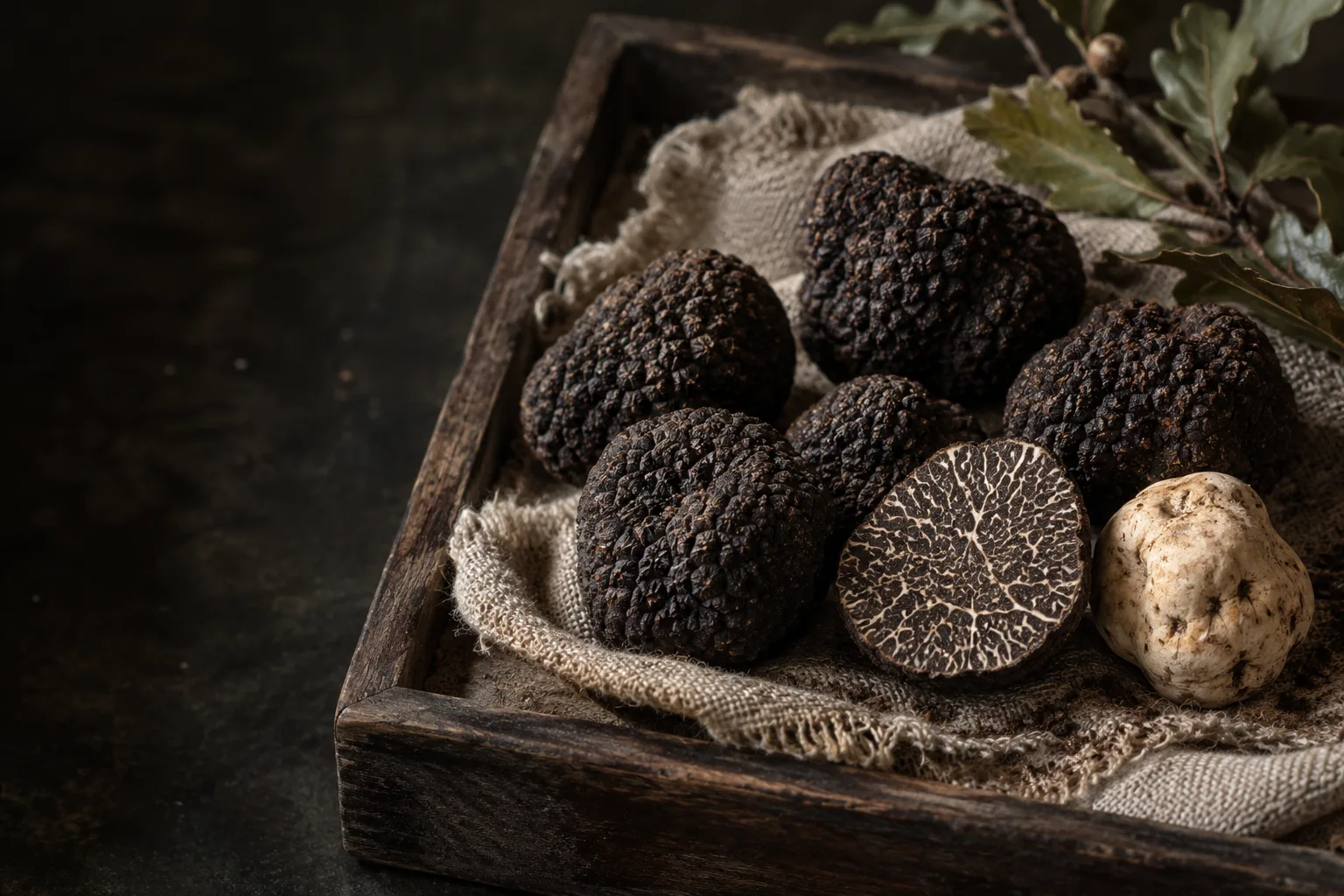
Black warty skin, dark flesh with fine white veins. Earth, woodland and nutty notes depend on maturity and freshness.
Explore the entry : Périgord black truffle Europe 03
Tuber aestivum
France · Italy · Spain · Croatia · Hungary · Romania · Bulgaria · Serbia · New Zealand
Dark skin with prominent warts and pale-veined flesh. Hazelnut and mushroom notes, often stronger in the autumn profile.
Explore the entry : Summer and Burgundy truffle Europe 04
Tuber brumale
France · Spain · Italy · Croatia · Serbia
Black skin, greyish to dark flesh, often broad pale veins. Strong aroma, sometimes musky or turnip-like.
Explore the entry : Winter truffle Europe 05
Tuber borchii
Italy · Croatia · Australia · New Zealand · United States
Pale truffle that may turn brown, with garlic and earthy notes, sometimes pungent. Intensity varies by lot.
Explore the entry : Bianchetto truffle Europe 06
Tuber macrosporum
Serbia · Hungary · Romania · Italy
Dark, finely rough surface; brown to rusty flesh with pale veins. Pronounced, slightly garlicky aroma.
Explore the entry : Smooth black truffle Europe 07
Tuber mesentericum
Black warty skin, often hollowed at the base; grey-brown flesh with white veins. Strong aroma, sometimes phenolic.
Explore the entry : Mesenteric truffle Asia 08
Commercial group known as Tuber indicum
Varies by species and region
Several Asian black truffles are sold under the name indicum. They may resemble T. melanosporum.
Explore the entry : Asian black truffles North America 09
Tuber oregonense
Marbled flesh; garlic and spicy notes.
Explore the entry : Oregon winter white truffle North America 10
Tuber gibbosum
Thin skin, brown flesh with white veins.
Explore the entry : Oregon spring white truffle North America 11
Leucangium carthusianum
Dark outer skin; fruity aroma recalling pineapple.
Explore the entry : Oregon black truffle North America 12
Kalapuya brunnea
Reddish-brown surface and garlic aroma.
Explore the entry : Oregon brown truffle North America 13
Tuber lyonii
United States · Canada · Mexico
Light brown skin, marbled flesh, nutty and earthy notes. Often associated with pecan trees.
Explore the entry : Pecan truffle North America 14
Tuber canaliculatum
Known as the Appalachian truffle, it was identified after a November 2025 harvest at the Waynesville research station.
Explore the entry : Appalachian truffle Desert truffles 15
Terfezia claveryi
Spain · Algeria · Saudi Arabia
Brownish desert truffle associated with rockroses, with a culinary profile distinct from European woodland truffles.
Explore the entry : Desert truffle — Terfezia claveryi Desert truffles 16
Terfezia boudieri
Dark desert truffle from arid habitats, harvested in association with rockroses.
Explore the entry : Desert truffle — Terfezia boudieri Desert truffles 17
Terfezia arenaria
Mediterranean truffle associated with sandy habitats, known as criadilha in Portugal.
Explore the entry : Sand truffle Desert truffles 18
Tirmania nivea
Tunisia · Libya · Algeria · Egypt
Pale desert truffle of genus Tirmania, distinct from Alba’s white truffle.
Explore the entry : White desert truffle Desert truffles 19
Tirmania pinoyi
Algeria · Libya · Iran · Syria
Another desert truffle species, similar in appearance to other Tirmania.
Explore the entry : Desert truffle — Tirmania pinoyi THE HARVEST CHANGES LATITUDE
Two winters.The same species. The black truffle Tuber melanosporum is cultivated far beyond its European origins. Provenance and harvest date matter more than a commercial name alone.
NORTHERN HEMISPHERE November — March Spain, France and Italy: the historic European regions. Harvests are also documented in the United States.
SOUTHERN HEMISPHERE June — August Australia, New Zealand, Chile, South Africa and Argentina: documented cultivation and harvests, with local calendars.
View details and sources HOW TO READ THIS ATLAS
The name is not enough. A season is a guide. Weather, latitude and maturity shift harvests. The atlas calendars do not replace local harvesting rules.
An entry does not certify a lot. Colour, photos and commercial names prove neither species nor origin. Specialist checks may be needed when in doubt.
An atlas that keeps growing. This selection is not an inventory of all known species. Scientific and professional sources are available in every entry.
Understanding traceability